HOME
Shop
  • English
  • 简体中文
HOME
Shop
  • English
  • 简体中文
  • Product Series

    • FPGA+ARM

      • GM-3568JHF

        • 1. Introduction

          • GM-3568JHF Introduction
        • 2. Quick Start

          • 01 Environment Construction
          • 02 Compilation Instructions
          • 03 Burning Guide
          • 04 Debugging Tools
          • 05 Software Update
          • 06 View information
          • 07 Test Command
          • 08 Application Compilation
          • 09 Source code acquisition
        • 3. Peripherals and Interfaces

          • USB
          • Display and touch
          • Ethernet
          • WIFI
          • Bluetooth
          • TF-Card
          • Audio
          • Serial Port
          • CAN
          • RTC
        • 4. Application Development

          • 01 UART read and write case
          • 02 Key detection case
          • 03 LED light flashing case
          • 04 MIPI screen detection case
          • 05 Read USB device information example
          • 06 FAN Detection Case
          • 07 FPGA FSPI Communication Case
          • 08 FPGA DMA read and write case
          • 09 GPS debugging case
          • 10 Ethernet Test Cases
          • 11 RS485 reading and writing examples
          • 12 FPGA IIC read and write examples
          • 13 PN532 NFC card reader case
          • 14 TF card reading and writing case
        • 5. QT Development

          • 01 ARM64 cross compiler environment construction
          • 02 QT program added automatic startup service
        • 6. Others

          • 01 Modification of the root directory file system
          • 02 System auto-start service
    • ShimetaPi

      • M4-R1

        • Introduction

          • M4-R1 Introduction
        • Get started quickly

          • OpenHarmony概述
          • 镜像烧录
          • 开发环境准备
          • Hello World应用以及部署
        • Application Development

          • getting Started

            • 第一章 ArkTS语言简介
            • 第二章 UI组件介绍和实际应用(上)
            • 第三章 UI组件介绍和实际应用(中)
            • 第四章 UI组件介绍和实际应用(下)
          • Advanced

            • 第一章 入门指引
            • 第二章 三方库的引用和使用
            • 第三章 应用编译以及部署
            • 第四章 命令行恢复出厂设置
            • 第五章 系统调试--HDC调试
            • 第六章 APP 稳定性测试
            • 第七章 应用测试
        • Equipment Development

          • 第一章 环境搭建
          • 第二章 下载源码
          • 第三章 编译源码
        • Peripherals and interfaces

          • 树莓派接口
          • GPIO 接口
          • I2C 接口
          • SPI通信
          • PWM控制
          • 串口通讯
          • TF Card
          • 屏幕
          • 触摸
          • 音频
          • RTC
          • Ethernet
          • M.2
          • MINI-PCIE
          • Camera
          • WIFI&BT
          • 树莓派拓展板
        • Frequently asked questions

          • 资源下载
      • M5-R1

        • Introduction

          • Introduction to ShimetaPi M5-R1
    • OpenHarmony

      • SC-3568HA

        • Introduction

          • SC-3568HA Overview
        • Quick Start Guide

          • OpenHarmony Overview
          • Image Flashing
          • Setting Up the Development Environment
          • Hello World Application and Deployment
        • Application Development

          • ArkUI

            • Chapter 1 Introduction to ArkTS Language
            • Chapter 2 Introduction to UI Components and Practical Applications (Part 1)
            • Chapter 3 Introduction to UI Components and Practical Applications (Part 2)
            • Chapter 4 Introduction to UI Components and Practical Applications (Part 3)
          • Expand

            • Chapter 1 Getting Started Guide
            • Chapter 2 Referencing and Using Third-Party Libraries
            • Chapter 3: Application Compilation and Deployment
            • Chapter 4: Command-Line Factory Reset
            • Chapter 5: System Debugging -- HDC (Huawei Device Connector) Debugging
            • Chapter 6 APP Stability Testing
            • Chapter 7 Application Testing
        • Device Development

          • Chapter 1 Environment Setup
          • Chapter 2 Download Source Code
          • Chapter 3 Compiling Source Code
        • Peripheral And Iinterface

          • Raspberry Pi interface
          • GPIO Interface
          • I2C Interface
          • SPI communication
          • PWM (Pulse Width Modulation) control
          • Serial port communication
          • TF Card
          • Display Screen
          • Touch
          • Audio
          • RTC
          • Ethernet
          • M.2
          • MINI-PCIE
          • Camera
          • WIFI&BT
          • Raspberry Pi expansion board
        • Frequently Asked Questions

          • Resource Downloads
      • M-K1HSE

        • Introduction

          • M-K1HSE Introduction
        • Quick Start

          • Development environment construction
          • Source code acquisition
          • Compilation Notes
          • Burning Guide
        • Peripherals and interfaces

          • 01 Audio
          • 02 RS485
          • 03 Display
        • System customization development

          • System transplant
          • System customization
          • Driver Development
          • System Debugging
          • OTA Update
    • EVS-Camera

      • CF-NRS1

        • 1. Introduction

          • Event Camera Technical Documentation
        • 2. Quick Start

          • Host driver and software installation
        • 3. SDK application development

          • API Usage Instructions
      • CF-CRA2

        • Introduction

          • About CF-NRS1
    • AI-model

      • 1684XB-32T

        • Introduction

          • AIBOX-1684XB-32 Introduction
        • Get started quickly

          • First time use
          • Network Configuration
          • Disk usage
          • Memory allocation
          • Fan Strategy
          • Firmware Upgrade
        • Deployment Tutorial

          • Algorithm deployment
          • Deploy Llama3 Example
        • Application Development

          • Sophgo SDK Development
          • Sophon LLM_api_server development
          • Deploy MiniCPM-V-2_6
          • Qwen-2-5-VL Image and Video Recognition DEMO
          • Qwen3-chat-DEMO
          • Qwen3-Qwen Agent-MCP-Demo
          • Qwen3-langchain-AI Agent
      • 1684X-416T

        • Introduction

          • AIBOX-1684X-416 Introduction
        • Demo simple operation guide

          • Simple instructions for using shimeta smart monitoring demo
    • Core-Board

      • C-3568BQ

        • Introduction

          • C-3568BQ Overview
      • C-3588LQ

        • Introduction

          • C-3588LQ Introduction
      • GC-3568JBAF

        • Introduction

          • GC-3568JBAF Introduction
      • C-K1BA

        • Introduction

          • C-K1BA Introduction

Firmware Upgrade

1. Preparation

  • 1x microSD card (capacity >= 16GB, minimum read/write speed class10, formatted as FAT32), the content needs to be empty
  • 1x microSD card reader
  • 12V power adapter (install the system image in the whole machine, the whole machine is powered by 12V)
  • A USB type-A to type-C data cable (for log output printing)

2. Upgrade process

  1. Please click the firmware download website to download the card upgrade package

Tips

Download path: ShimetaPi AI智能硬件 > GM-1684XBASE-32T > 01-系统镜像 > sdcard_1012.tar.gz

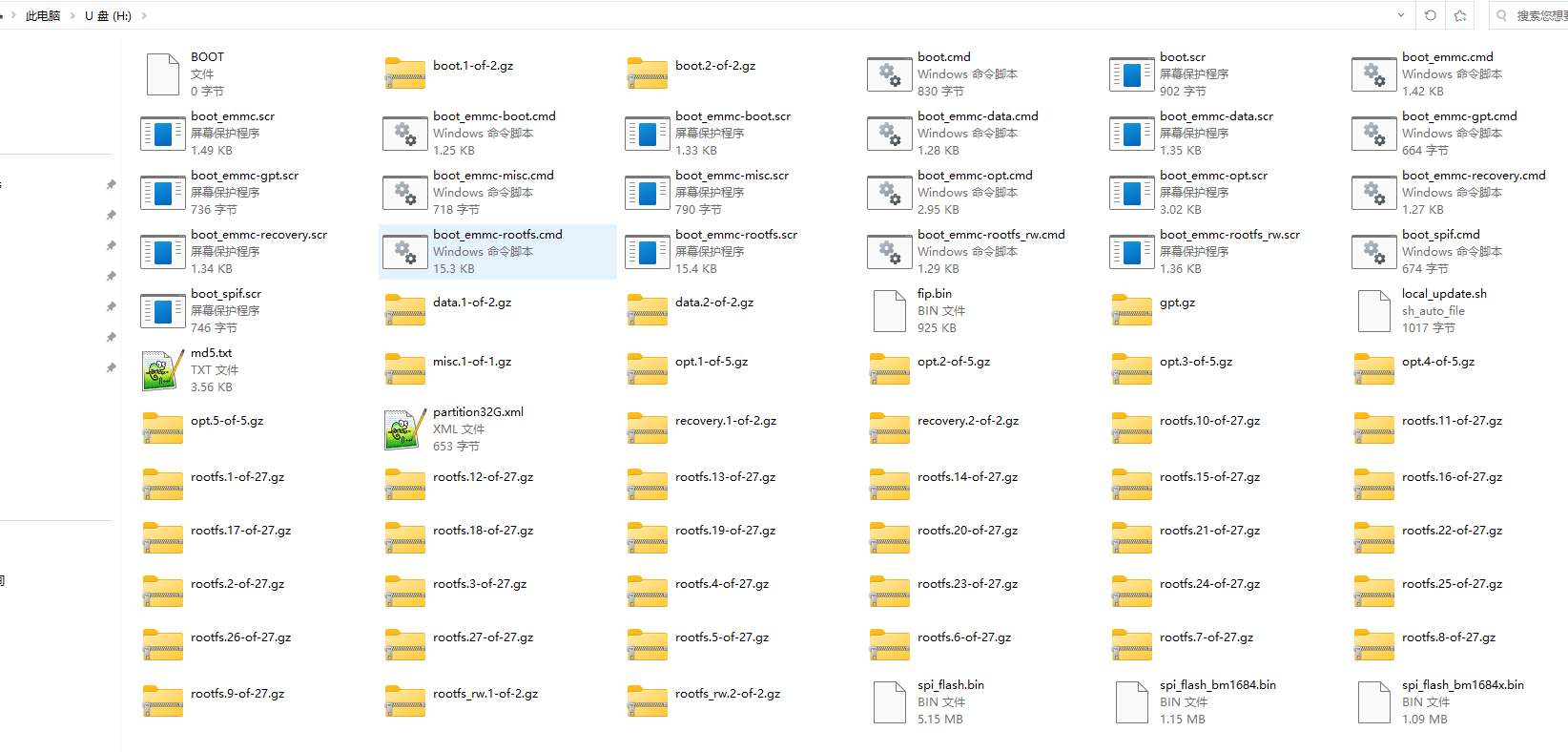
  1. Unzip the compressed package on the local computer and then copy it to the root directory of the SD card (/mnt is the root directory of the SD card)
TOOL
  1. Insert the SD card into the card slot, power on, and press the power button. If the following log is observed in the serial port, it means that the firmware is being flashed. The process takes about 3 to 5 minutes.

    MMC write: dev # 0, block # 0, count 34 ... 34 blocks written: OK

    fs reading //boot_emmc-boot.scr
    1362 bytes read in 10 ms (132.8 KiB/s)
    ## Executing script at 300040000
    fs reading //boot.1-of-2.gz
    25748902 bytes read in 3202 ms (7.7 MiB/s)

    Uncompressed size: 102760448 = 0x6200000


    MMC write: dev # 0, block # 8192, count 200704 ... 200704 blocks written: OK

    fs reading //boot.2-of-2.gz
    30566 bytes read in 13 ms (2.2 MiB/s)

    Uncompressed size: 31457280 = 0x1E00000


    MMC write: dev # 0, block # 208896, count 61440 ... 61440 blocks written: OK

    fs reading //boot_emmc-recovery.scr
    1374 bytes read in 10 ms (133.8 KiB/s)
    ## Executing script at 300040000
    fs reading //recovery.1-of-2.gz
    6470860 bytes read in 813 ms (7.6 MiB/s)

    Uncompressed size: 102760448 = 0x6200000
  1. After the flashing is completed, you will see the red LED light is always on, and the log will prompt you to unplug the SD card, and then power off and on to restart
    eMMC update done
    bm savelog 449 bytes written in 10 ms (43 KiB/s)
    all done
    Please remove the installation medium, then reboot
    Please remove the installation medium, then reboot
    Please remove the installation medium, then reboot
    Please remove the installation medium, then reboot
    Please remove the installation medium, then reboot
    Please remove the installation medium, then reboot
    Please remove the installation medium, then reboot
    Please remove the installation medium, then reboot
    Please remove the installation medium, then reboot
    Please remove the installation medium, then reboot
    Please remove the installation medium, then reboot
    Please remove the installation medium, then reboot
    Please remove the installation medium, then reboot
    Please remove the installation medium, then reboot
    Please remove the installation medium, then reboot
    Please remove the installation medium, then reboot
    Please remove the installation medium, then reboot
    Please remove the installation medium, then reboot
    Please remove the installation medium, then reboot
    Please remove the installation medium, then reboot
    Please remove the installation medium, then reboot

3. Important Tips

Warning

If the burning process fails, it is generally caused by the overheating of the chip. In this case, please wait until the chip cools down to a certain extent, then power it on again and enter the flashing process.


Edit this page on GitHub
Last Updated:
Contributors: zsl, zwhuang
Prev
Fan Strategy