
Hybrid Vision SDK Overview
📋 Overview
HVAlgo is a high-performance algorithm library designed by ShiMetaPi for event cameras, providing a range of advanced event denoising, computer-vision, and image-restoration algorithms. Built on the ShiMetaPi Hybrid Vision SDK, it supports real-time event-stream processing and is suited to robotic vision, autonomous driving, high-speed motion analysis, and similar applications.
The ShiMetaPi Hybrid Vision SDK is composed of two independent SDKs — hybrid_vision_toolkit and hybrid_vision_algo — which implement interface control and algorithm processing for the hybrid vision camera respectively.
🚀 Where to start
- Want it running immediately: Your First C++ Program (open the camera and capture events in 5 minutes)
- Want to learn by task: Programming Guides (open camera / read events / record / denoise / display / tune)
- Want a no-code preview: MultiVision Studio
- Want ready-made examples: Samples Overview
📋 SDK overall architecture
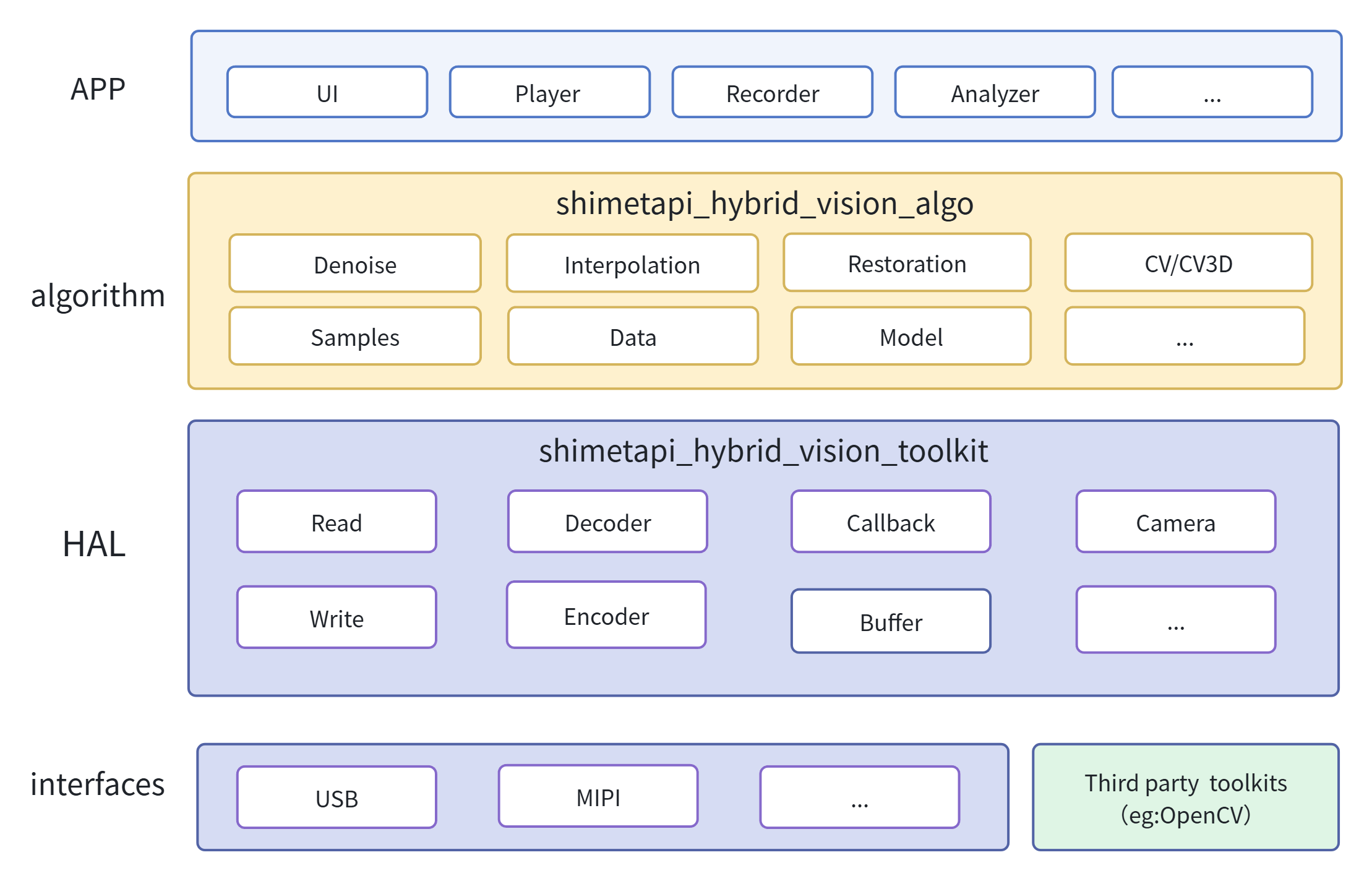
shimetapi_Hybrid_vision_algo (algorithm-layer SDK)
- Role: This is the core algorithm-processing layer of the SDK, the middle layer of the architecture (the yellow part).
- Core function: It focuses on processing the raw data stream from the event camera and executing advanced computer-vision algorithms to improve data quality, extract useful information, or perform 3D understanding.
- Included modules:
- Denoise: removes noise from the event stream to improve signal quality.
- Interpolation: used to generate intermediate data points between events, or for spatiotemporal alignment/fusion with standard frame images.
- Restoration: used to handle missing data or anomalies.
- Computer Vision / 3D Vision (CV/CV3D): algorithms specific to event cameras or fusion applications — object detection, tracking, 3D reconstruction, pose estimation, etc.
- Samples & data: sample code, models, or required datasets.
- External dependencies: integrates third-party libraries to give users more device choices, e.g.
shimetapi Hybrid vision toolkit, OpenEB (installed via command), etc.
- Effect: It provides processed, enhanced, or understood event data to upper-layer applications (
APP). Application developers mainly call the interfaces of this layer to implement the advanced features of the event camera (playback, recording, analysis).
shimetapi_Hybrid_vision_toolkit (HAL-layer toolkit)
- Role: This is the Hardware Abstraction Layer (HAL) and base tool layer of the SDK, at the very bottom of the architecture (the dark-blue part labeled
HAL). - Core function: Provides hardware interaction and basic data-stream operations. It reads raw data from the physical interface, does preliminary processing (e.g. encode/decode), passes the data to the upper algorithm layer through its callback and buffer mechanisms, and also provides camera-device abstraction and control.
- Key modules / functions:
- Read: gets the raw event data stream from the hardware interface.
- Decoder: if event data is transmitted in a specific encoded format, decodes it into a processable format.
- Callback: asynchronously pushes captured/decoded data to the upper layer via callbacks, so the application does not have to poll.
- Camera: abstraction and control of camera devices (device discovery, open/close, parameter configuration, etc.).
- Write: sends processed data or control commands back to the hardware (if supported).
- Encoder: encodes processed data or recorded streams into a specific format.
- Buffer: data-buffer management, responsible for data movement and memory reuse, smoothing the data flow between capture and processing.
- Supported hardware interfaces: the
interfaceslayer at the bottom of the block diagram listsUSB,MIPI, etc. (...means more); the toolkit abstracts different physical interfaces into unified backends, hiding transport-layer differences. - Effect: It abstracts the details of the underlying hardware and transport interfaces and provides a unified, relatively hardware-independent interface for the upper algorithm layer (
shimetapi_Hybrid_vision_algo) to access and control the event-camera data stream. It handles the underlying communication protocol, data movement, and basic format conversion.
Summary of how the two relate and cooperate:
shimetapi_Hybrid_vision_toolkit (toolkit / HAL layer):- Deals directly with the hardware and the underlying system SDK.
- Acquires raw data (
Read), does basic format conversion (Decoder), delivers data via callbacks (Callback), manages the data flow with buffers (Buffer), and outputs data (Write,Encoder), etc. - Provides a standardized data-access interface to the upper (
algo) layer.
shimetapi_Hybrid_vision_algo (algorithm layer):- Built on top of the
toolkitlayer. - Receives the standardized event data stream from the
toolkitlayer. - Uses its advanced algorithm modules (
Denoise,Interpolation,CV/CV3D, etc.) to process, enhance, analyze, and understand the data. - Provides the processed, more valuable information to the topmost application (
APP) — e.g. display (UI),Playerplayback,Recorderrecording,Analyzeranalysis. - Compatible with different vendor interfaces (currently supports ShiMetaPi HV Toolkit and OpenEB).
- Built on top of the